Build It Yourself: The Creators Who Stopped Waiting for the Right App
There's a moment a lot of creatives hit — usually somewhere between the third subscription renewal and the fourth time a platform "improves" itself into something unrecognizable — where they think: what if I just made my own thing?
For most people, that thought dissolves by morning. But for a quietly growing slice of the digital creative world, it became a whole new direction. Artists, designers, illustrators, and experimental makers are learning to code not because they want to become developers, but because they want tools that actually match how their brains work. And in doing so, they're accidentally discovering that the act of building is just as creative as anything the tool eventually produces.
The App Store Isn't Built for You Specifically
Here's the thing about commercial software: it's designed for the broadest possible audience. Photoshop, Figma, Procreate — these are incredible tools built to serve millions of different workflows. But that scale comes with trade-offs. Features get buried. Workflows get standardized. The software nudges you, subtly, toward certain kinds of outputs.
When you build your own tool — even a rough, barely-functional one — there's no nudging. There's no interface guiding you toward the "correct" way to do something. You're working in a space that only exists because you made it exist, shaped entirely around your specific creative logic.
That's a genuinely different experience. And for a lot of creators, it's addictive.
Small creative studios and independent artists across the US have started sharing their custom-built scripts, generative tools, and DIY software on platforms like GitHub, Are.na, and even just their personal websites. Some of it is polished. A lot of it is messy. All of it is distinctly theirs.
Learning to Code as a Creative Act
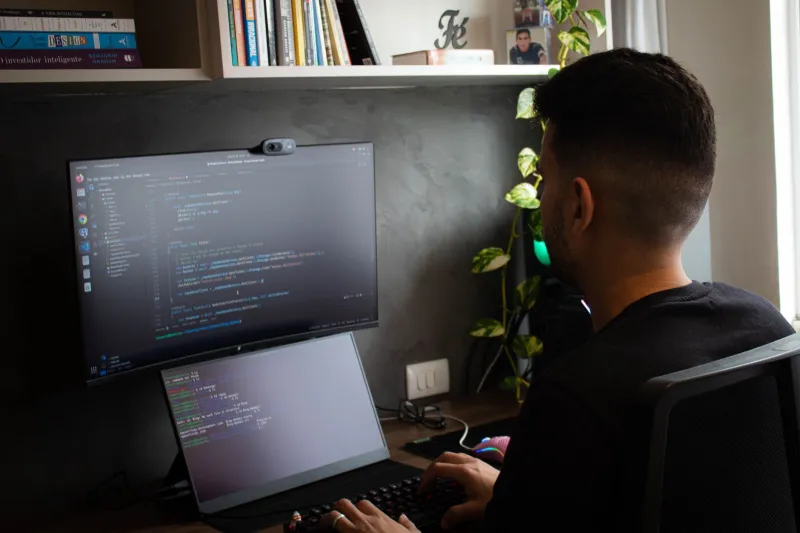
The tools people are building range wildly. Some creators write simple Python scripts that automate tedious parts of their process — batch-resizing images in a specific way, or generating color palettes from audio files. Others go deeper, building entire generative systems in Processing or p5.js that create visuals based on rules they invented.
What's interesting is how many of these creators describe the learning process itself as transformative. You start trying to solve a specific problem — "I want my animation tool to respond to sound differently" — and you end up understanding something fundamental about how digital systems work. That knowledge bleeds back into everything.
There's also something worth noting about the texture of self-built tools. Commercial software is optimized to be smooth. Bugs get patched. Rough edges get rounded off. But when you're coding your own thing and something breaks in an unexpected way, you often don't fix it — you follow it. Some of the most distinctive digital aesthetics circulating right now came from creators chasing a glitch in something they built themselves.
The Limitation Is the Feature
This is maybe the most counterintuitive part of the whole movement: constraints that would be deal-breakers in commercial software become generative in a DIY context.
When you build a drawing tool that only works in one color, or a layout system that can only handle three columns, or a video effect that takes forty-five minutes to render, you're not working around limitations — you're working with them. The limitation shapes what you make. It creates a signature.
A lot of the most recognizable visual work happening in digital spaces right now has that quality. You can feel that it came from a specific, idiosyncratic system. It doesn't look like it was made in Canva or filtered through a Lightroom preset. It looks like it came from somewhere particular, and that particularity is what makes it stick.
Commercial tools, for all their power, tend to flatten that particularity. They're too good at making things look professional. And "professional" is increasingly indistinguishable from "generic."
Who's Actually Doing This
The community is more diverse than you might expect. It's not just programmers who got into art. It's painters who got tired of digital painting apps that didn't feel right. Graphic designers frustrated with how subscription tools keep changing their pricing and feature sets. Animators who wanted motion behavior that didn't exist anywhere. Poets who wanted to generate text in ways that felt more like collage than autocomplete.
The creative coding scene — communities built around tools like Processing, openFrameworks, TouchDesigner, and the browser-based p5.js — has been around for a while, but it's grown noticeably more accessible over the past few years. YouTube tutorials, open-source libraries, and active Discord communities have lowered the floor dramatically. You don't need a CS degree. You need curiosity and a willingness to break things.
Colleges and art schools are starting to reflect this shift too. Programs that once separated "studio art" from "computer science" are increasingly blurring that line, producing graduates who think of code as just another material — like paint or clay or light.
Your Tool, Your Voice
There's a deeper argument here that goes beyond aesthetics or workflow. When you use the same tools as everyone else, you're working inside someone else's vision of what creativity looks like. The interface encodes assumptions. The default settings push you in certain directions. Over time, those nudges add up.
Building your own tools is a way of opting out of that. It's a way of saying: my creative process is specific enough that it deserves its own infrastructure. That's a statement about how seriously you take your own practice.
It's also, honestly, just fun in a way that scrolling through app stores really isn't. There's something deeply satisfying about making a thing that does exactly what you want it to do — even if "exactly what you want" is pretty weird and nobody else would ever use it.
The Output Looks Different
If you spend any time in digital art spaces — on Are.na, on personal portfolio sites, in the corners of Instagram that the algorithm hasn't fully colonized — you can usually tell when something was made with a custom tool. It has a specificity that commercial software struggles to replicate. The proportions are slightly off in an interesting way. The color relationships are unexpected. The motion feels like it was invented for this particular piece rather than pulled from a preset library.
That specificity is what audiences are increasingly responding to. In a content environment where everything is optimized and smoothed and A/B tested into palatability, work that feels genuinely handmade — even if "handmade" means "written in JavaScript at 2am" — stands out.
The handmade internet isn't a nostalgic throwback. It's a creative frontier. And the people building their own tools aren't just solving workflow problems — they're making the act of building part of what they have to say.