Chaos Archive: Why Your Messy Screenshot Folder Might Be Your Best Creative Asset
Somewhere on your computer, there's a folder. Maybe it's called "Inspo" or "Random" or just "Screenshots" — the one that auto-fills every time you hit Command+Shift+4. It's got a cropped image of a font you liked on a restaurant menu, a blurry photo of a shadow on a sidewalk, and three different screenshots of the same blue you've been obsessed with for six months. You've never actually used any of it. But you can't delete it either.
Here's the thing: that pile of digital clutter isn't a problem. For a growing number of creatives, it's the whole point.
The Moodboard That Builds Itself
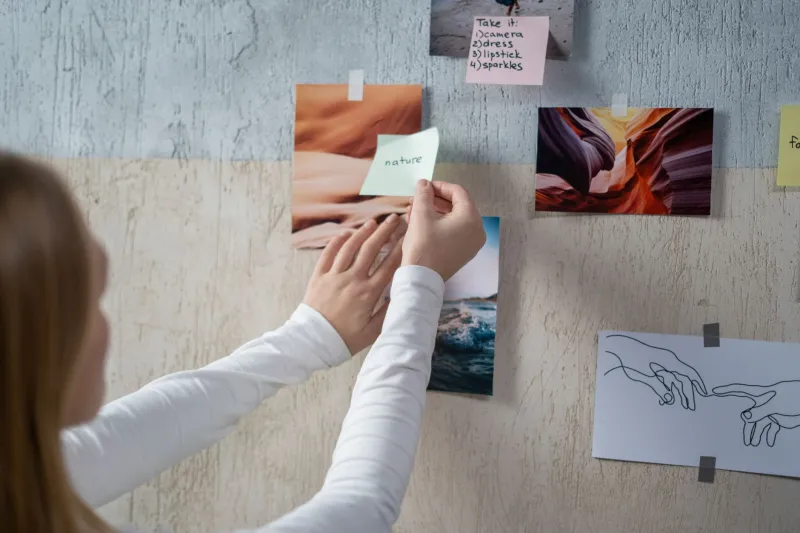
The traditional moodboard was always a curated thing — intentional, edited, assembled with purpose before a project kicked off. You'd pull images that matched the brief, arrange them neatly in a grid, and present them to a client or collaborator as proof that you understood the assignment.
But a lot of working designers and artists will tell you that the stuff they actually draw from looks nothing like that. It looks like a mess. It looks like five years of impulsive saving with no organizational logic whatsoever.
Illustratorand surface designer Maya Cortez, based in Portland, describes her reference folder as "basically a brain dump that never gets emptied." She's been saving images since 2017 — everything from architectural details she photographed on her phone to screenshots of color palettes from video games she doesn't even play anymore. "I stopped trying to organize it," she says. "The chaos is kind of the point. When I go back in looking for one thing, I always find something I forgot I saved, and that's usually the thing that actually solves the problem."
That accidental rediscovery is at the heart of what's happening here. Creatives are learning to trust the accumulation — to let the archive build itself and then mine it later, often for projects the original saves were never intended for.
There's Actually Psychology Behind This
Creative researchers have a term for this kind of thinking: divergent accumulation. The idea is that broad, non-linear collecting — even when it feels random — builds a kind of associative web in your brain. When you're deep in a project and stuck, that web catches things your conscious mind wouldn't have reached for.
Essentially, you're outsourcing part of your creative intuition to an archive. The folder remembers things your brain filed under "not useful yet."
This is why some designers are now treating their chaotic saves not as pre-project prep, but as an ongoing creative practice in their own right. The act of noticing something worth saving — a color, a texture, a weird typographic choice on a gas station sign — is itself a form of looking. And looking, done consistently, sharpens the eye in ways that no design course can fully replicate.
When the Archive Becomes the Aesthetic
For some artists, the chaotic folder has crossed over from inspiration source to actual output. Graphic artist and digital collage maker Theo Vance, who works out of Brooklyn, started posting directly from his screenshot archive about two years ago — pulling raw, uncropped captures, layering them with minimal editing, and releasing them as finished pieces.
"People kept asking me what my process was," he says. "And I realized the process was the archive. I wasn't making work and then saving references — I was saving constantly, and the work was emerging from that."
The results have a specific, hard-to-replicate texture. Because the source material spans years and contexts, nothing in Vance's work looks like it came from the same visual universe — and yet it all feels cohesive, because the sensibility doing the collecting was always his. The chaos has a fingerprint.
This is the thing about an unfiltered personal archive: it's almost impossible to fake. You can study someone's aesthetic and copy their output, but you can't reproduce the specific accumulation of what they found interesting over five years of living their particular life.
Practical Chaos: Making the Method Work
If you want to actually use your digital hoarding as a design tool rather than just a source of mild anxiety, a few things help.
Don't over-organize. This sounds counterintuitive, but heavy folder structures and tagging systems can actually flatten the archive — making it easier to find specific things but harder to stumble across unexpected connections. Some designers keep one main folder and let it sprawl.
Review it without a project in mind. Set aside time to scroll through your saves when you're not actively working on anything. This is when the associative thinking happens — when you're not looking for something specific and your brain is free to make weird lateral jumps.
Let time do the filtering. Stuff you saved three years ago and forgot about is often more interesting than what you saved last week. Distance creates perspective. Something you screenshotted in 2021 without knowing why might make complete sense to you now.
Save ugly things too. The instinct is to only save beautiful or obviously inspiring content. But the weird, the off-putting, and the visually awkward stuff is often more generative — it creates friction, and friction produces ideas.
The Folder as Self-Portrait
There's something else going on here that's worth naming. A creative archive built up over years without curation or performance pressure is one of the more honest self-portraits a person can make. It's not what you think you should like — it's what you actually kept coming back to, in the private moments when no one was watching.
In an online environment where every creative decision gets filtered through the lens of audience and algorithm, that kind of unguarded accumulation is genuinely rare. The messy folder is the one place where you're not performing taste — you're just having it.
And increasingly, that's where the most interesting work is starting.