Spilled Coffee, Torn Paper, Actual Gold: The Creatives Turning Physical Accidents Into Digital Art
Let's say you're working on a watercolor piece and you knock your coffee mug. The liquid spreads across the paper in a way that's genuinely beautiful — warm brown bleeding into wet pigment, edges that no brush could have made. Your first instinct is probably frustration. Maybe you grab a paper towel.
But a growing number of artists would tell you to put the paper towel down, let it dry, and then scan it at 600 DPI.
Because that accident? That's the work now.
The Mistake as Medium
There's always been a tradition in art of embracing the unplanned — happy accidents, as the late Bob Ross called them with characteristic gentleness. But what's happening right now in certain corners of the digital art market goes further than that. Creators aren't just incorporating accidents into their work. They're actively seeking them out, engineering conditions where mistakes are likely, and then digitizing the results with the same care and intention they'd bring to any finished piece.
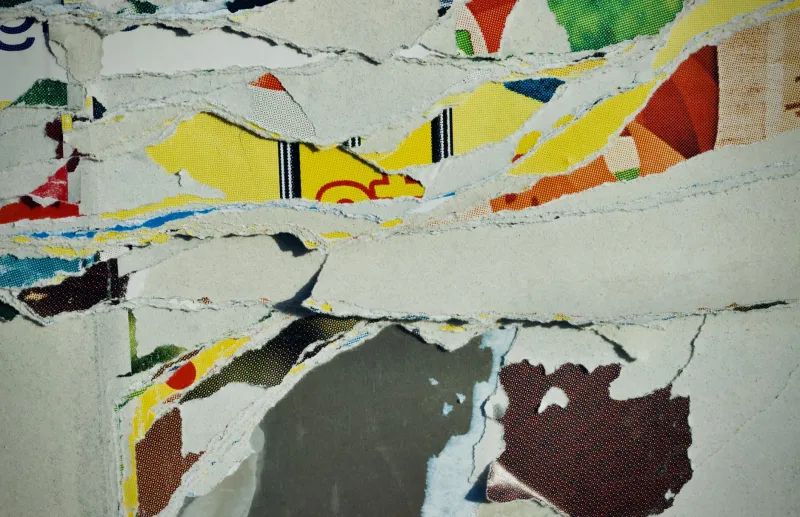
The outputs — high-resolution scans of wrinkled paper, ink bleeds, torn photographs, paint smears, coffee stains, fingerprints, water damage — are being sold as NFTs, licensed as digital assets, printed as fine art editions, and used as textures and backgrounds by designers who want something that looks genuinely, irreproducibly human.
That last part is key. In an era when AI can generate a polished illustration in seconds, the thing that's becoming genuinely scarce is evidence of a human hand — especially a human hand that slipped.
Why Imperfection Has Market Value Right Now
The economics here are worth sitting with for a second, because they're legitimately strange. Digital art, by its nature, is infinitely reproducible. A file can be copied without degradation. And yet the market for digital art that looks physically imperfect — that carries the visual DNA of a material accident — is real and growing.
Part of this is aesthetic. There's a widespread hunger right now for textures that feel analog, for visual evidence of process and material. Design trends have been cycling back toward grain, noise, and physical imperfection for several years, and that appetite has created genuine demand for source material that can't be algorithmically generated.
But there's also something more philosophical happening. An AI can produce a convincing coffee stain texture. What it cannot produce is this specific coffee stain, made by this specific person, on this specific afternoon, on a piece of paper that was also carrying the residue of three previous working sessions. The provenance is part of the value. The accident is documented, located in a real body's real experience.
That's the thing digital perfection can't fake.
The Artists Doing It
Brooklyn-based mixed media artist Juno Reyes started scanning her studio mistakes about eighteen months ago after a particularly rough week in which she ruined three pieces she'd been working on. "I was going to throw everything away," she says. "And then I looked at the ruined pieces and thought — these actually look incredible. The damage was more interesting than what I was trying to make."
She started releasing the scans as a standalone series called Evidence, selling prints and limited digital editions. The response surprised her. "People connected with it more than almost anything else I've made. I think because it's honest in a way that finished work often isn't. You're seeing what happened, not what I intended."
On the more technically experimental end, artist and designer Cal Nakamura has developed what he calls a "damage practice" — a set of deliberate interventions he performs on physical paper before scanning. Soaking pages in coffee or tea. Pressing wet leaves against ink. Running printed pages through water and letting them dry wrinkled. Folding and unfolding until the paper develops a specific texture of creases.
"I'm not waiting for accidents," he says. "I'm creating conditions where interesting things happen, and then I'm capturing those things. It's still a practice. It's still intentional. I just moved the intentionality to a different stage of the process."
Nakamura licenses his scanned textures through a private shop, selling to designers and brands who use them in packaging, editorial layouts, and digital campaigns. His work shows up in places you'd never know to look for it — a wrinkled paper texture on a skincare brand's website, a torn-edge element in a magazine spread. The mistake, commodified and distributed.
The Scanning Is Its Own Art Form
Something that comes up repeatedly when you talk to artists working this way is how much craft goes into the digitization itself. A bad scan of a beautiful accident is just a bad scan. Getting the physical object to translate into a digital file with its full texture, depth, and tonal range intact requires real technical knowledge — the right scanner settings, the right resolution, sometimes multiple passes at different exposures.
Some artists do post-processing work to enhance what the scanner captures; others are strict about keeping the digital version as close to the physical original as possible. Either way, the scanning process forces a kind of close attention to the accident — you're studying it, assessing it, making decisions about how to represent it. The mistake gets examined more carefully than most finished work does.
This is, in a weird way, a form of respect. The accident gets treated as a subject worth understanding.
The Irony Isn't Lost on Anyone
There's an obvious tension here that the artists working in this space are mostly happy to acknowledge: they're taking the most materially specific, physically located, unrepeatable artifacts of analog making — the evidence that something happened in the real world — and converting them into infinitely reproducible digital files.
The coffee stain can be copied. The original paper, with its specific smell and weight and texture, cannot.
But most of these artists see that tension as generative rather than contradictory. The digital version is a record, a documentation, a translation. It carries information about the physical event even if it can't replicate the event itself. And in an increasingly virtual creative economy, that translation — the bridge between the physical accident and the digital artifact — might be one of the more interesting places to work.
Juno Reyes puts it simply: "The mistake happened in real life. The scan proves it. That proof is worth something."
She's not wrong.